

The “Great Talker” Paradox: 5 Surprising Insights from an Agent Sales Performance Report
Introduction: Beyond the Raw Data
Every sales manager has encountered the “Great Talker” — the agent who possesses a silver tongue, builds effortless rapport, and sounds like a superstar on every call. Yet, when the month-end figures arrive, their conversion rates tell a different story. This creates a frustrating dilemma: how do you coach someone who seems to be doing everything right but isn’t getting results?
This is where the Agent Sales Performance Report becomes a strategic asset. As an AI-driven tool from CXEX’s AutoInsights suite, it replaces the hit-or-miss nature of manual QA with a single source of truth. By automatically synthesising 16 separate interactions from agent Kumar Sangakkara’s January 2026 performance — representing roughly 144 minutes of conversation — we can pinpoint hidden friction points without a manager having to listen to every second of audio. The resulting data reveals why “sounding good” is often a poor proxy for “selling well.”
Why This Report Exists
At its core, the Agent Sales Performance Report answers one question that keeps sales leaders up at night: are our conversations actually driving conversions, handling resistance well, and getting the most out of every opportunity — and if not, where exactly are we losing momentum?
Traditional sales reporting tends to stop at revenue and conversion rates. Those numbers tell you what happened, but rarely why. They can’t explain why conversion rates swing from month to month, where in the funnel deals quietly stall, which specific objections leave an agent stuck, or whether a slump comes from a genuine product gap or simply weak pipeline management.
This report digs into the mechanics underneath the outcomes:
- Sales methodology execution — from discovery through to the close
- Objection handling — and how efficiently resistance gets resolved
- Product knowledge — and how well value is positioned
- Call-level behavioural patterns and soft skills
- Skill progression and consistency over time
That depth lets managers tell apart problems that look identical on the surface but call for very different coaching — strong rapport that never converts into a close, solid product knowledge undermined by thin discovery, reliable wins on warm leads paired with a soft spot for cold objections, or a one-off missed target versus a systemic skill gap.
Without that structured view, coaching becomes reactive guesswork. With it, improving the pipeline turns into something you can measure, predict, and target.
Takeaway 1: High Rapport Does Not Guarantee a High Score
One of the most striking findings in Kumar’s report is the statistical “see-saw” between soft skills and structural effectiveness. Kumar achieved a perfect 100% pass rate in Rapport Building and was praised for “strong rapport and empathy.” However, despite being the team’s most likable communicator, his overall QA score dropped from 94 to 82 compared to the previous month.

This discrepancy highlights a critical reality in sales psychology: being “likable” is a foundation, not the finish line. The report shows a significant Variance to Team where Kumar is +19% better than his peers in Objection Handling but -11% lower in Closing Techniques. This suggests that high rapport can actually mask underlying weaknesses — a pleasant conversation often lulls an agent into a false sense of security, causing them to neglect the rigorous framework required to move a prospect from a “pleasant chat” to a signed contract.
Takeaway 2: The “Objection Handling” Illusion
Kumar’s performance presents a fascinating paradox regarding objections. He maintains a high 97% score in Objection Handling, boasting a perfect 100% success rate for “Price Objections” and “Need More Information.” On paper, he is winning the battle of wits. However, his Sales Likelihood remained at 0%.
The reason for this disconnect becomes clear when we look at the specific types of resistance. While Kumar handles “Price” well, his overcome rate for “Implementation Concern” was 0%. He can defend the cost, but he fails when the conversation shifts to the logistics of how the product actually works. As the report notes:
“The agent effectively overcomes most objections… however, the lack of closing and follow-up reduces the impact of successful objection handling on final sales outcomes.”

This reveals that “winning the argument” is not the same as winning the sale. If objection handling isn’t used as a bridge to the close, the momentum is entirely wasted.
Takeaway 3: The 38% Closing Gap
The most significant bottleneck in Kumar’s performance is the transition from education to commitment. His score for Closing Techniques sits at 38%. While this is an improvement from last month’s 29%, it still lags significantly behind the team average of 49%.
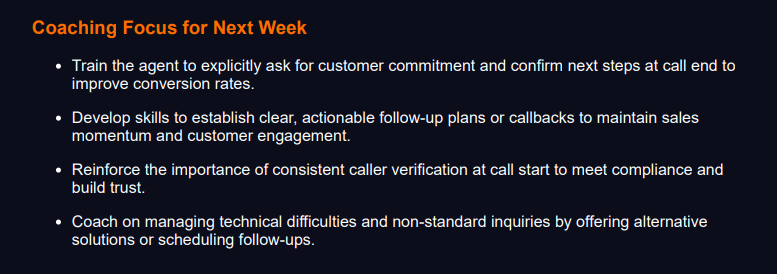
The strategic insight here is stark: Kumar boasts a 98% score in the Discovery Process, meaning he understands the customer’s needs perfectly. But high discovery without a close is simply “free consulting.” To transform this curiosity into revenue, the report identifies specific coaching actions:
- Explicitly ask for customer commitment at the end of every call.
- Confirm specific next steps so the prospect has a clear roadmap.
- Establish agreed-upon follow-up plans or callbacks to maintain momentum.
- Avoid open-ended conclusions, even when customer interest appears high.
Takeaway 4: The Compliance Blind Spot in High-Performance Conversations
It is often assumed that agents with the highest technical proficiency are the most diligent regarding protocol. Kumar challenges this assumption. Despite a perfect 100% pass rate (16 out of 16) in Product Knowledge, his application of “Caller Verification” was inconsistently applied.
Skipping fundamental compliance steps undermines the very trust that rapport is designed to build. If an agent demonstrates deep expertise in policy details but fails to verify the caller’s identity, the professional integrity of the interaction is compromised. This is why the coaching focus for the upcoming week emphasises that regulatory adherence is a non-negotiable component of quality, regardless of how well an agent knows the product.
Takeaway 5: When Technical Friction Kills the Momentum
The report identifies a specific “Coaching Call” (Id: 177069_1) where technical difficulties and website navigation issues derailed the flow of the conversation. Because the agent failed to offer alternative solutions or a structured follow-up, the interaction resulted in a lost sales opportunity.
The data suggests this isn’t just an isolated glitch but a pattern of behaviour. Kumar’s Average Talk Time is 8:59, notably shorter than the team average of 10:27. This discrepancy suggests that when Kumar hits technical friction or non-standard inquiries, he may be rushing the call or ending the interaction prematurely rather than navigating the complexity. True sales mastery requires the ability to pivot — moving the customer away from a technical hurdle and toward a scheduled resolution or an alternative path to purchase.
Conclusion: From Data to Actionable Coaching
The evidence from the January 2026 report is clear: sales performance is a chain, and it is only as strong as its weakest link. In Kumar’s case, the chain is exceptionally strong through discovery and rapport but breaks at the point of commitment.
By using CXEX’s AutoInsights, sales leaders no longer have to guess why a “good talker” isn’t producing “good numbers.” These reports replace manual QA efforts with evidence-based operational intelligence, pinpointing exactly where the revenue stalls.
As you look at your own team’s performance this month, ask yourself: Is your team winning the conversation but losing the commitment — and do you have the data to tell the difference?