


5 Surprising Insights Your VOC Monthly Report Is Trying to Tell You (But You’re Probably Missing)
Modern leaders are often drowning in metrics but starving for genuine insight. In the world of Customer Experience, looking only at high-level averages is a dangerous form of confirmation bias. The VOC Monthly Report is designed to be your most rigorous “health check,” moving beyond raw data to provide a comprehensive view of sentiment, loyalty, and satisfaction.
As we analyse the March performance data, it becomes clear that these reports are more than a summary; they are a diagnostic tool. Ignoring the nuances within them is like a doctor ignoring a patient’s failing heart just because their body temperature appears normal. Here is what the data is actually telling you.
Why This Report Exists
The Voice of Customer (VOC) Report exists to answer one fundamental experience question: how do our customers genuinely feel about dealing with us, what is driving their loyalty or frustration, and where do we need to intervene to protect retention?
Traditional operational reporting tends to fixate on internal metrics — speed, volume, handle time. But efficiency alone never explains why satisfaction wobbles even when we hit every internal handling target, where friction buried in our processes is quietly eroding brand loyalty, which specific pain points are triggering negative sentiment, whether shifting complaint topics signal an emerging systemic failure, or how a customer’s real-world story contrasts with the tidy quantitative score we report upstairs.
This report digs into all of it:
- Macro experience health — CSAT, NPS, and Net Sentiment
- Chronological variation and short-term shifts — Weekly Trends
- The core drivers of customer emotion — positive and negative experience themes
- Topic migration and newly emerging concerns
- Qualitative feedback (the Concise VoC Story) alongside strategic recommendations
That depth lets leadership tell apart situations that look the same on a dashboard but call for completely different action — a process that runs efficiently yet leaves customers feeling unheard, short-term transactional frustration versus a genuine collapse in long-term loyalty, an isolated grievance versus a recurring structural pain point, and a sentiment swing caused by agent behaviour versus one caused by a policy change.
Without structured experience insight, service strategy stays entirely inward-looking. With it, sentiment becomes operationalised, friction points become visible, and retention strategy becomes something you can actually target.
1. The “Silent” Loyalty Risk: Why CSAT Isn’t Enough
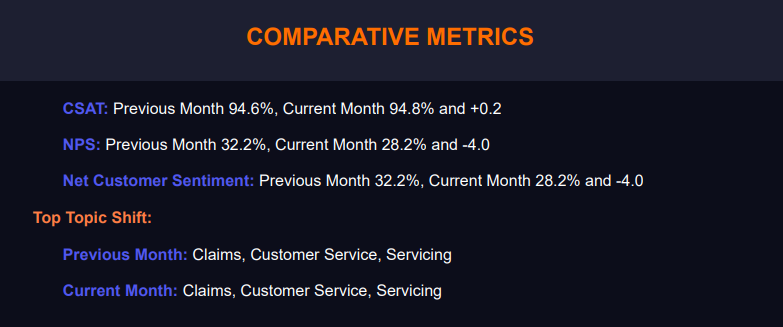
One of the most dangerous traps in CX is over-relying on Customer Satisfaction (CSAT) scores. The March data reveals a striking paradox: CSAT remained exceptionally strong at 94.8% (a +0.2 increase), yet the Net Promoter Score (NPS) — the primary indicator of long-term loyalty — dropped by 4.0 points to 28.2%.
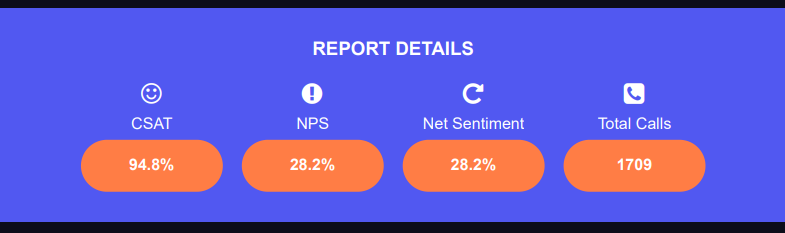
This discrepancy highlights a “silent” loyalty risk where high satisfaction with an agent coexists with deep mistrust of the brand. In March, customers explicitly praised “clear communication” and “helpful agents,” which drove the high CSAT. However, those same customers expressed frustration with “policy limitations” and “billing issues.”
“The billing dispute and payment overdue handling left me feeling unheard and mistrustful.”
This quote from the March report bridges the gap: an agent can follow every procedure perfectly, but if the underlying policy is unhelpful, the customer will not recommend you. Loyalty isn’t earned by the agent’s tone; it’s lost through the brand’s rigid policy management.
2. Looking Beyond the “Average” with Weekly Trends
Monthly averages are deceptive because they smooth out the volatile reality of daily operations. The “Weekly VOC Performance Metrics” section is critical because it identifies “problem weeks” that are otherwise hidden.
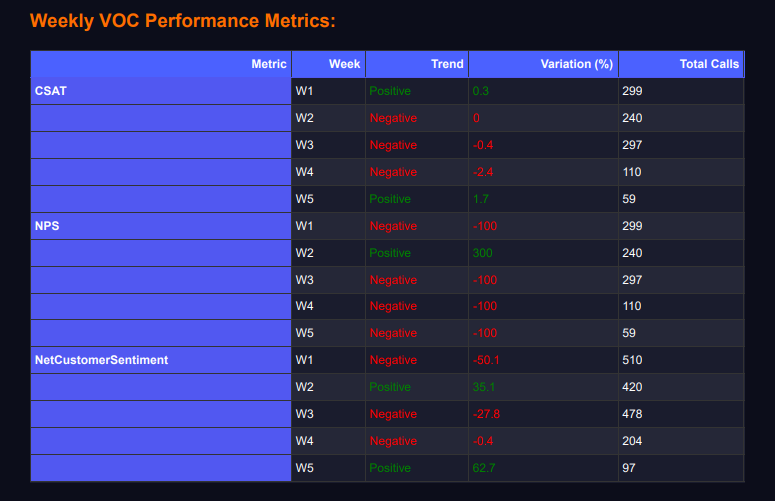
In March, the monthly NPS of 28.2% masks a near-total collapse in loyalty for most of the month. While Week 2 saw a positive trend of 300%, Weeks 1, 3, 4, and 5 all saw a staggering -100% variation in NPS. This wasn’t just a slight dip — it was a consistent metric failure across 80% of the month. Identifying these specific windows allows leadership to correlate the collapse with specific operational changes or external events rather than dismissing it as a general monthly trend.
3. The Power of “Topic Shifts” as an Early Warning System
The “Track Topic Shifts” feature is intended to act as an early warning system, showing when customer concerns migrate from one area to another. However, there is a secondary, more concerning insight to be found when topics don’t shift.
In the March report, the top topics for both the previous and current month remained identical: Claims, Customer Service, and Servicing. For a CX Strategist, this lack of shift is a red flag. It indicates that these are chronic, unresolved pain points. If your negative themes aren’t moving, your current strategies to fix the core experience are failing to gain traction. A stagnant topic list in the face of declining NPS means you are stuck in a cycle of “reactive firefighting” rather than proactive resolution.
4. 100% Analysis vs. The Survey Trap
Traditional customer feedback relies on survey sampling, which typically captures a tiny 2–5% of your customer base — usually only the loudest voices. The AutoInsights VOC approach eliminates this “survey trap” by analysing the total population of interactions, such as the 1,709 calls processed in March.
This provides a multi-dimensional view derived from every conversation, not just a polarised sample. By analysing 100% of interactions, the report generates a “Concise VoC Story” that captures the nuanced reality of the customer’s journey.
“The agent communicated clearly, was helpful in guiding the claim process despite delays… [but] I will just suggest all the people in my group that don’t go for Carpeesh again because you guys are not helpful with the claim.”
This level of narrative insight is only possible when you analyse the entire dataset. It reveals the friction between a positive agent interaction and a negative process outcome — a detail that a standard “1-to-10” survey score would completely miss.
5. Turning Sentiment into a Strategic Roadmap
The ultimate value of a VOC report is its ability to convert “negative themes” into a prioritised, actionable roadmap. The March report doesn’t just list grievances; it provides specific strategic recommendations with measurable “Expected Outcomes.”
To reverse the current trends, the roadmap focuses on two high-leverage areas:
- Root Cause & Automation: Investing in root cause analysis tools and workflow automation to eliminate systemic friction in policy management and billing.
- Proactive Resolution: Implementing proactive billing dispute resolution workflows to reduce payment-related dissatisfaction and lower complaint volumes by 10%.
By focusing on these specific technical and procedural fixes — rather than just “better service” — the report aims to increase NPS by 5 percentage points. This turns the VOC report from a backward-looking document into a strategic engine for growth.
Summary: From Numbers to Narrative
The Voice of the Customer Monthly Report is most effective when used to find the story behind the data. Scores like 94.8% CSAT are indicators, but the true insight lies in the “why” behind the -100% NPS weekly drops and the chronic themes that refuse to shift.
As you review your next report, ask yourself: Are you simply looking for the scores you want to see, or are you prepared to act on the uncomfortable truths hidden behind high satisfaction scores? Transforming those conversations into a better experience requires the courage to look beyond the average.