


The Policy Paradox: Why 80% of Your Customer Issues Remain Unresolved (And How to Fix It)
In the high-stakes arena of Customer Experience (CX), the “unresolved call” is the ultimate friction point. For the customer, it is a failure of promise; for the business, it is a toxic driver of operational costs and diminished Lifetime Value (LTV). Despite the heavy investment in modern contact centre stacks, a staggering gap persists between merely answering a call and actually closing the loop on a customer’s needs.
The Issue Resolution Deep Dive Report for March 2026 provides a sobering look into this “Resolution Gap.” Leveraging AI-synthesised interaction data to analyse 100% of conversations — rather than relying on biased manual sampling — the report reveals that out of 1,005 total calls, 504 (nearly 50%) remained unresolved. As a strategic lead, one must ask: why are our sophisticated systems failing to solve every second problem? The data indicates that the bottleneck isn’t agent talent — it is organisational design.
Why This Report Exists
The Issue Resolution Deep Dive Report exists to answer one strategic question: what are the systemic root causes, structural bottlenecks, and policy limitations stopping our frontline agents from achieving final closure — and where does the business itself need to adapt?
Traditional operational reporting tells us how many calls stay unresolved. What it never explains is why specific issues stall or break down, where rigid corporate policy strips an agent of the power to fix a problem, which pain points stem from broken internal processes rather than product failures, whether agent actions are genuinely resolving issues or just managing and deferring them, and how volume in complex subcategories is shifting over time.
To get at that, this report digs into:
- Upstream root causes — policy, process, system, and customer factors
- The narrative and behavioural patterns behind unresolved interactions
- Final agent action themes — transfers, follow-ups, and ownership gaps
- Subcategory call-volume shifts and emerging friction trends
- Strategic, business-level operational recommendations
That depth lets managers separate problems that look alike but have opposite fixes — an agent who lacks training versus one who lacks organisational authority, a minor procedural hitch versus a systemic cross-functional bottleneck, expected transactional volume versus an emerging high-risk trend, and isolated customer friction versus a widespread, policy-driven roadblock.
Without structured deep dives, leadership stays stuck treating symptoms. With them, the bottlenecks become visible, agent empowerment becomes actionable, and process optimisation becomes genuinely strategic.
Takeaway #1: The “Policy Prison” is the Primary Resolution Killer
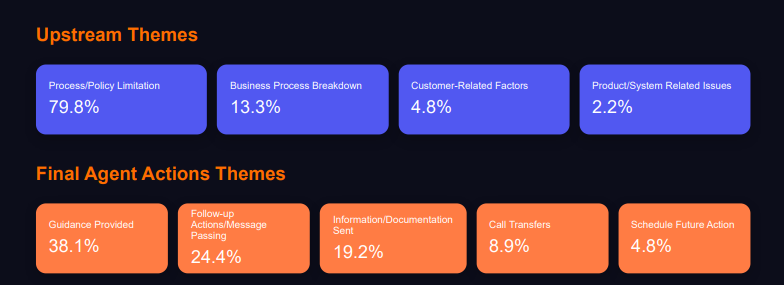
The most damning statistic in the March data is that 79.8% of unresolved cases are driven by “Process/Policy Limitations.” We are currently trapping our frontline in a “Policy Prison,” where agents are cognitively aware of the solution but are contractually or procedurally prohibited from executing it.
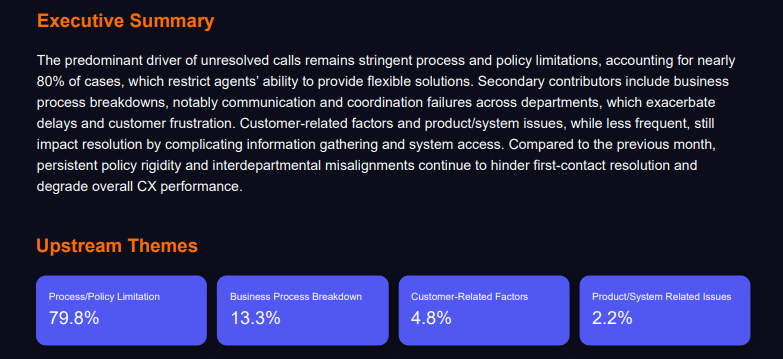
This “Policy Rigidity” manifests when agents are denied the authority to approve refunds, adjust claims, or expedite workflows without manual, high-level authorisations. While these guardrails are often designed to mitigate risk or control costs, they frequently achieve the opposite. By preventing a resolution at the first point of contact, organisations inadvertently spike their “Cost-to-Serve” through high volumes of repeat contacts.
“Simplify and revise restrictive policies to empower agents with greater discretion for refunds, claim adjustments, and expedited processing, reducing bottlenecks and improving first-contact resolution rates.”
Takeaway #2: Agents are Informed, but Powerless
There is a sharp contrast between an agent’s ability to provide guidance and their ability to provide a resolution. In 38.1% of unresolved cases, the final action was “Guidance Provided.” This suggests that agents are functioning as expensive information relays — explaining why a policy prevents a fix — rather than empowered problem solvers.
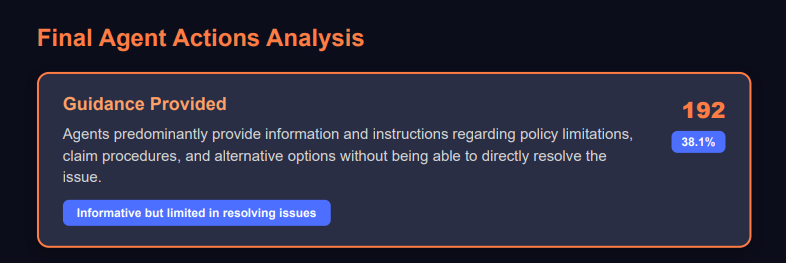
Furthermore, the “Follow-up/Message Passing” rate of 24.4% highlights a systemic failure of “ownership.” When nearly a quarter of all calls result in an agent passing the buck to another team or a future date, the Customer Effort Score (CES) skyrockets.
“[This reveals the impact of] upstream systemic barriers on frontline agent effectiveness and customer experience.”
When agents lack the autonomy to close a case, they aren’t managing resolutions — they are merely managing the customer’s frustration.
Takeaway #3: The Hidden Cost of Interdepartmental Silos
Beyond rigid rules, “Business Process Breakdowns” account for 13.3% of unresolved inquiries. These failures are primarily the result of cross-departmental communication gaps and misrouting, which force customers to navigate a fragmented corporate structure.
This lack of coordination is evident in the 8.9% call transfer rate. Every transfer represents a failure of the initial touchpoint and a compounding of customer effort. Additionally, “Information/Documentation Sent” accounts for 19.2% of actions. While often seen as “procedural adherence,” this is frequently an empty gesture that masks “Customer Information and Authorisation Gaps” (4.8%). Agents send forms to satisfy a checklist, but without the authority to act on that information once returned, the cycle of friction continues.
Takeaway #4: Surprising Trends in the March Data
The March 2026 data highlights specific emerging pressure points that threaten to overwhelm current structures. Comparing this period to the previous month, we see two alarming shifts:
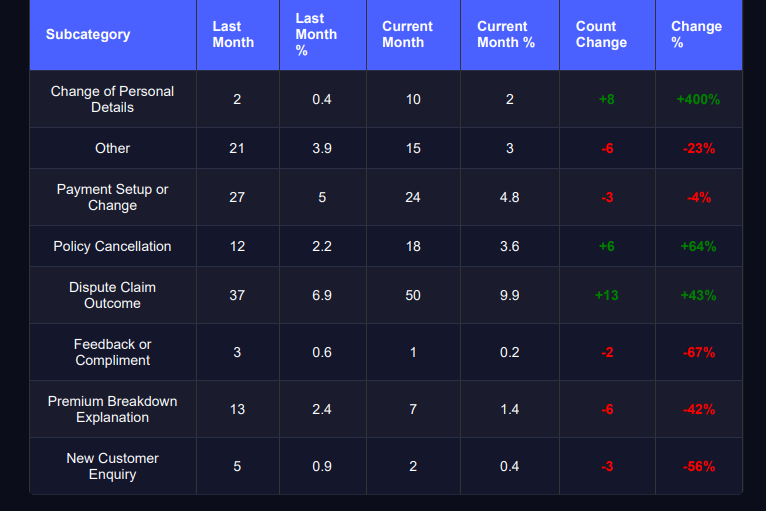
- Change of Personal Details: Volume surged by a staggering 400%.
- Dispute Claim Outcome: These high-emotion interactions rose by 43%.
In a rigid environment, a 400% spike in a routine task like updating personal details becomes an operational catastrophe. If a simple address or name change requires the “manual, high-level authorisations” mentioned in the report, the system bottlenecks instantly. When combined with a 43% rise in claim disputes — where the “Policy Prison” is at its most restrictive — you have a recipe for a total breakdown in customer loyalty.
Conclusion: From Management to Empowerment
The insights from the March 2026 report lead to a singular strategic conclusion: issue resolution is an organisational design problem, not an agent performance problem. High failure rates are the logical outcome of a system that prioritises “procedural adherence” over “closure.”
To move the needle on First-Contact Resolution (FCR) and lower the total Cost-to-Serve, leadership must adopt the report’s primary Business Level Recommendation: prioritise actions that directly impact resolution time by stripping away redundant authorisations.
As you audit your own CX framework, you must answer one fundamental question: Are your company policies serving as guardrails to protect the business, or are they handcuffs that prevent your agents from delivering the value your customers demand?