


What 2,472 Call Transcripts Reveal About the Future of Customer Service Automation
1. Why Guesswork Fails in Customer Service Automation
The graveyard of digital transformation is littered with “intuitive” bots — expensive assets built on vendor pressure and executive gut feelings rather than the hard reality of customer behaviour. When organisations automate based on guesswork, they don’t just risk poor containment rates; they face a massive financial sinkhole where high-cost technology is deployed to solve problems that don’t actually exist.
The Digitalisation Discovery Report is the antidote to this intuition trap. By leveraging AI to perform an exhaustive analysis of 2,472 real conversation transcripts, this report replaces “I think” with “the data shows.” It provides a structural transformation blueprint that identifies where automation will flourish and where human empathy must remain, turning raw conversational data into a high-precision strategic roadmap.
2. What the Digitalisation Discovery Report Was Designed to Solve
The Digitalisation Discovery Report exists to answer one of the most commercially loaded operational questions there is: which customer interactions should we automate — and what measurable return will it actually deliver?
Most organisations chase automation on intuition, vendor pressure, or a few isolated journey reviews. This report replaces that guesswork with evidence. Using AI analysis of real call transcripts, it pinpoints the high-volume automation candidates, the genuine deflection potential, the estimated agent hours saved, the cost benefit, the right channel for each intent (IVR, voice bot, or hybrid), and the order in which to roll it all out.
That detail lets leadership draw the distinctions that make or break a programme — true automation-ready intents versus complex, human-dependent journeys; quick wins versus longer-term strategic builds; full automation versus hybrid escalation models; and tactical savings versus genuine structural transformation.
Without transcript-level analysis, automation initiatives gamble on low containment, poor CX, and thin ROI. With it, conversational data becomes an actual digital transformation roadmap.
3. 58% of Customer Interactions Show Automation Potential
Our October 2025 analysis uncovers a hidden goldmine of efficiency. Within a dataset of 2,472 calls, the report revealed that 58% of customer interactions are currently suitable for automation or self-service channels.
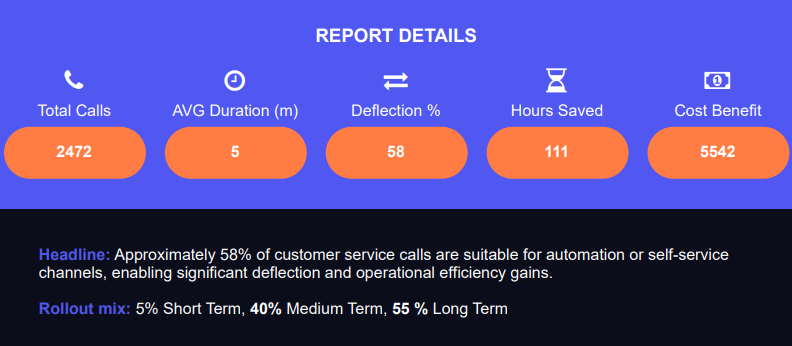
The immediate operational capacity uplift is stark. Based on an average agent cost of £50 per hour, automating these interactions would reclaim 111 agent hours and generate £5,542 in cost benefits from this sample alone. This isn’t just a “nice-to-have” feature; it is a fundamental operational necessity. In a landscape where scaling human talent is increasingly expensive, a 58% deflection potential represents a decisive shift from tactical savings to structural operational health.
“Approximately 58% of customer service calls are suitable for automation or self-service channels, enabling significant deflection and operational efficiency gains.”
4. Why High-Volume Calls Are Not Always the Best Automation Starting Point
A common pitfall for digital strategists is the “Volume Fallacy” — the belief that the most frequent calls should be the first to be automated. However, our Prioritisation Rule demands a more sophisticated balance of four critical pillars: Automation Score, technical complexity, backend data requirements, and strategic importance.
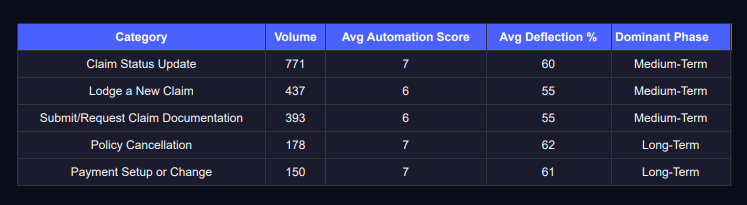
Consider the contrast: “Claim Status Updates” accounted for a massive 771 calls, yet were categorised for the Medium-Term rollout. Meanwhile, “Policy Cancellations” (178 calls) and “Payment Setup” (150 calls) boast high Automation Scores but are strictly Long-Term objectives. This sequencing accounts for the “Sensitivity Barrier.” A policy cancellation is a high-risk journey where losing a customer is on the line — it requires careful escalation handling and robust authentication that must be perfected before a bot is allowed to lead the conversation.
5. The Medium-Term Automation Opportunity Where ROI Really Lives
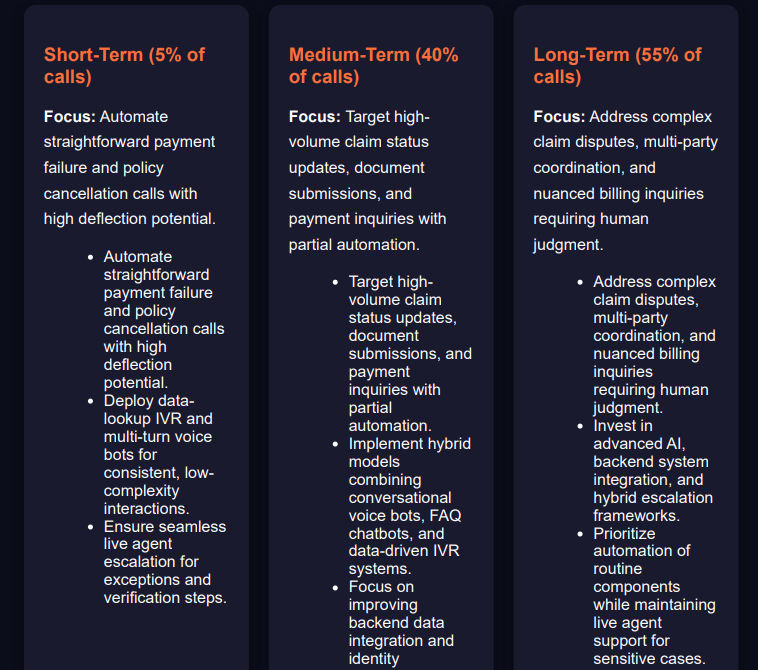
While the 5% Short-Term “Quick Wins” — such as straightforward payment failures — provide an immediate proof of concept, the true engine of ROI is the Medium-Term phase, which represents 40% of the total automation opportunity.
This category includes:
- Claim Status Updates
- Document Submissions
- Payment Inquiries
The strategy here is not “all-or-nothing” automation, but a Hybrid Model. For example, even high-volume claim status inquiries require agents for personalised explanations and occasional human judgement. By implementing multi-turn voice bots that handle the procedural heavy lifting — gathering claim numbers and verifying statuses — while maintaining a seamless “warm handover” to agents for nuance, organisations achieve partial automation that supports, rather than replaces, the human workforce.
6. Why CRM and System Integration Determine Automation Success
A bot’s containment rate is a direct reflection of its access to real-time data. To move beyond shallow FAQ interactions and achieve true “Agentic AI” status, the automation strategy must be anchored by a technical backbone.
The Digitalisation Discovery Report identifies four critical integration requirements:
- CRM Integration: For real-time customer and policy data lookup.
- Identity Verification (Authentication): The gatekeeper for handling sensitive or personalised data securely.
- Scheduling and Booking Systems: Critical for managing claims and hire car arrangements without human intervention.
- Knowledge Bases: Ensuring the bot provides consistent, procedurally accurate guidance.
Digital success is as much a technical challenge as it is a behavioural one. Without these integrations, bots remain surface-level, leading to high escalation rates and fractured customer experiences.
7. The Insight-First Approach to AI Automation Strategy
The core methodology of this report represents a fundamental shift in how we build. Traditional approaches buy the technology first and hunt for a problem later. The “Insight First” philosophy flips the script, using AI-driven transcript analysis to define the solution before a single line of code is written.
To ensure total transparency for Bot Builders and Solution Architects, the report includes a downloadable Excel dataset containing the underlying call-level data. This raw dataset — featuring Call IDs, intent classifications, and automation scores — serves as the ultimate bridge between high-level strategic insight and technical execution.
“Most automation programmes fail because they start with technology. This report ensures automation starts with insight.”
8. How Transcript Analysis Supports Smarter Digital Transformation
A successful digital roadmap rests on three pillars: Quantifiable ROI, Strategic Prioritisation, and Sustained CX. By analysing actual conversation data rather than theoretical use cases, businesses can move away from reactive cost-cutting and toward a structured, proactive digital transformation.
The question for leadership is no longer whether to automate, but whether your strategy is built on the shaky ground of intuition or the hard evidence of your own customer conversations. Moving to evidence-based insights is the only way to deliver measurable efficiency, true capacity uplift, and a future-proof customer experience.